On Wednesday 14 October 2026, the actor Danny Dyer joined campaigners from SOS Whitstable to hand in a petition at 10 Downing Street calling for the water industry to be returned to public ownership. Before the handover, they took a giant inflatable poo down the Thames by boat.
Whether to nationalise the water industry is a political question, and we don't take sides on it here. What we can do is test the claims about sewage and bathing water against the Environment Agency (EA) data. In short: the spills are real, but the sea at Leysdown, and across England, is far cleaner than it was in Dyer's childhood.
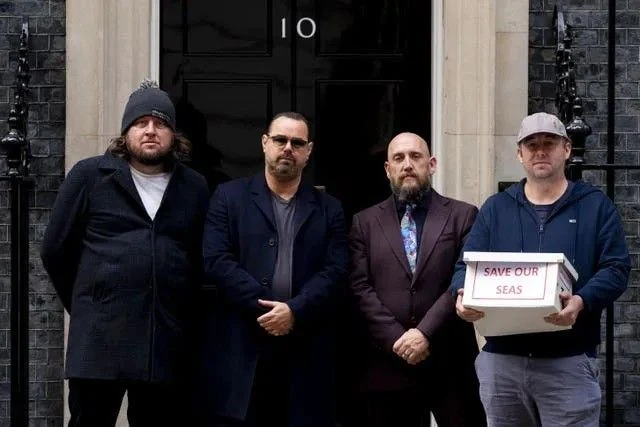
From left: Jimi Butcher of Priory Hill, Danny Dyer, Sittingbourne and Sheppey MP Kevin McKenna, and SOS Whitstable co-founder Ed Acteson outside No 10 on 14 October 2026. Photo: Jordan Pettitt/PA.
The petition
Ed Acteson of SOS Whitstable started the petition, Return the Water Industry to Public Ownership, on Change.org on 16 August 2022. When we checked on 17 October 2026, it had 352,682 signatures. It makes two main factual claims:
"In recent years, the water industry has discharged hundreds of thousands of hours of raw sewage into English and Welsh rivers, lakes and coastal waters, the equivalent of decades' worth of pollution being dumped into our natural environment."
"This crisis has spiralled out of control, causing severe environmental damage, harming tourism and coastal economies, and putting public health at risk."
Some reports this week said the petition will now be considered for a debate in Parliament. Petitions with 100,000 signatures are considered for debate, but only those on Parliament's own site, not Change.org. A separate parliamentary petition, Hold a referendum to bring the water industry into public ownership, got 213,751 signatures and was debated in Westminster Hall on 14 September 2026. It closed on 1 October 2026.
What Danny Dyer has said
These are his words as reported, with the source for each:
- "Sometimes when you look out to the sea, you can smell the twang in the air." He also called the water quality "a disgrace" and said: "It's a very dangerous thing." (BBC News, 20 September 2026, at the Leysdown protest on Sheppey)
- "My holidays used to be in a caravan in Canvey Island. It was a bit of a sh*thole but I could always get in the sea." (Sheppey Scene, 21 September 2026)
- "Our water bills are going up so we are paying them more to pump the sh*t into the sea." (Sheppey Scene)
- "...the people that are meant to be running our water companies – are pumping raw sewage into the seas. I didn't know that this was a thing, and I didn't know how dangerous it was... because it's dangerous [for] kids." (Caravan magazine via Out and About Live)
- "Let's stand up and say we're not having it no more." (KentOnline, 20 September 2026)
The claims against the data
1. "Pumping raw sewage into the seas": true, the spills are real
He's right that sewage overflows discharge into the sea, including near the Leysdown caravan park he runs in his TV series. The EA's 2025 storm overflow return lists four overflows linked to the Leysdown bathing water. Between them, they recorded 13 counted spills lasting about 32 hours in 2025:
- Barrows Brook overflow, Eastchurch, which discharges into the stream it is named after: 8 spills, 23.6 hours (the biggest)
- Little Groves Leysdown pumping station: 2 spills, 6.3 hours
- Mustards Road pumping station: 2 spills, 1.0 hours
- Warden Bay pumping station: 1 spill, 0.9 hours
Across England in 2025, the EA's annual return counts 292,119 spills lasting 1,878,240 hours from 14,239 overflows with spill data. The petition's "hundreds of thousands of hours" is, if anything, an understatement. The EA's own announcement gave 291,492 spills, a figure since revised.
Two things put those totals in context. First, 2025 was a drier year. Total spill duration was 48% lower than in 2024, and spills per overflow fell from 31.8 to 20.5; rainfall drives most of the swing. Second, recorded spills rose for years mainly because monitoring did, from 862 monitored overflows in 2016 to more than 14,000 now. Overflows aren't new. What's new is that we can see them.
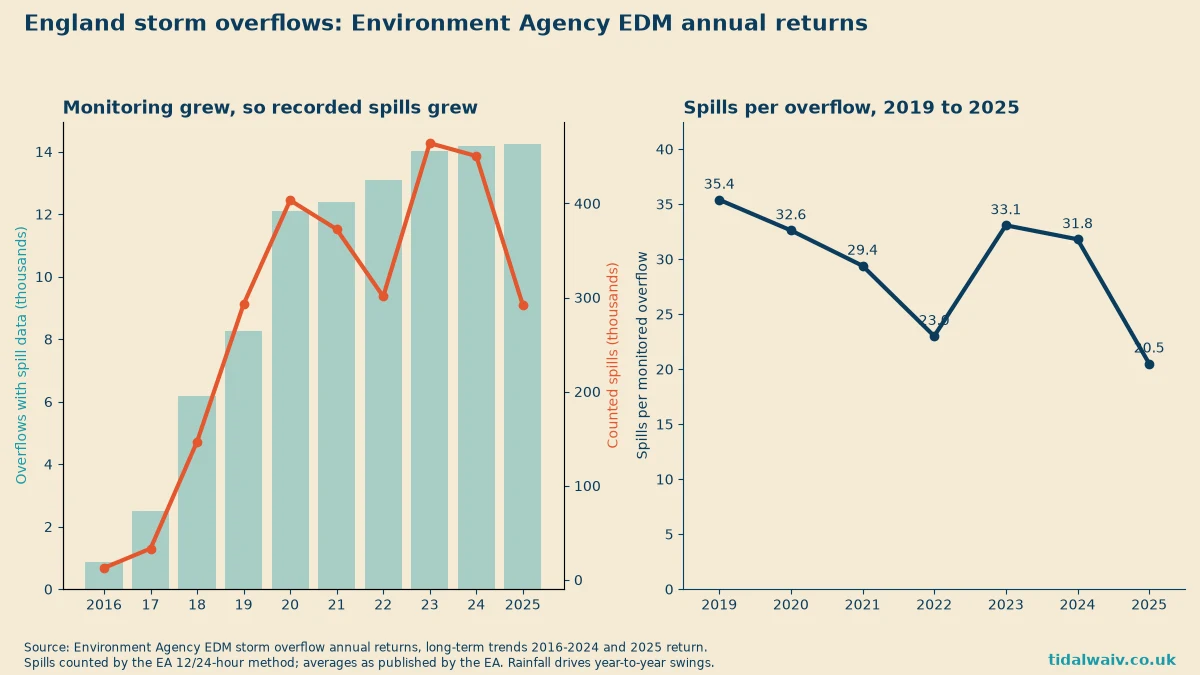
The EDM data records how often and for how long an overflow runs. It doesn't measure volume, or how dilute the discharge is.
2. Leysdown's water is "a disgrace" and "very dangerous": not what the testing shows
Leysdown has one of the longest records on TidalWaiv: 787 samples since 1988. The EA rated it Good in 2025, as it did every year from 2022 to 2025. It was Excellent in 2015, 2017, 2019 and 2021.
The 2025 rating is based on 80 samples from 2022 to 2025. What holds Leysdown at Good is intestinal enterococci, not E. coli:
- E. coli: the 95th percentile was 111.5 CFU/100ml, comfortably inside the Excellent limit of 250.
- Intestinal enterococci: the 95th percentile was 122, just over the Excellent limit of 100 and well inside the Good limit of 200.
Of the 20 samples taken in 2025, the highest readings were 160 E. coli and 290 enterococci, both on 24 July. The worst 2026 sample so far was 420 E. coli and 500 enterococci on 9 September. Those spikes are real and worth knowing about. But a beach rated Good meets the legal standard, and the BBC noted that the EA's site recorded no pollution incidents there.
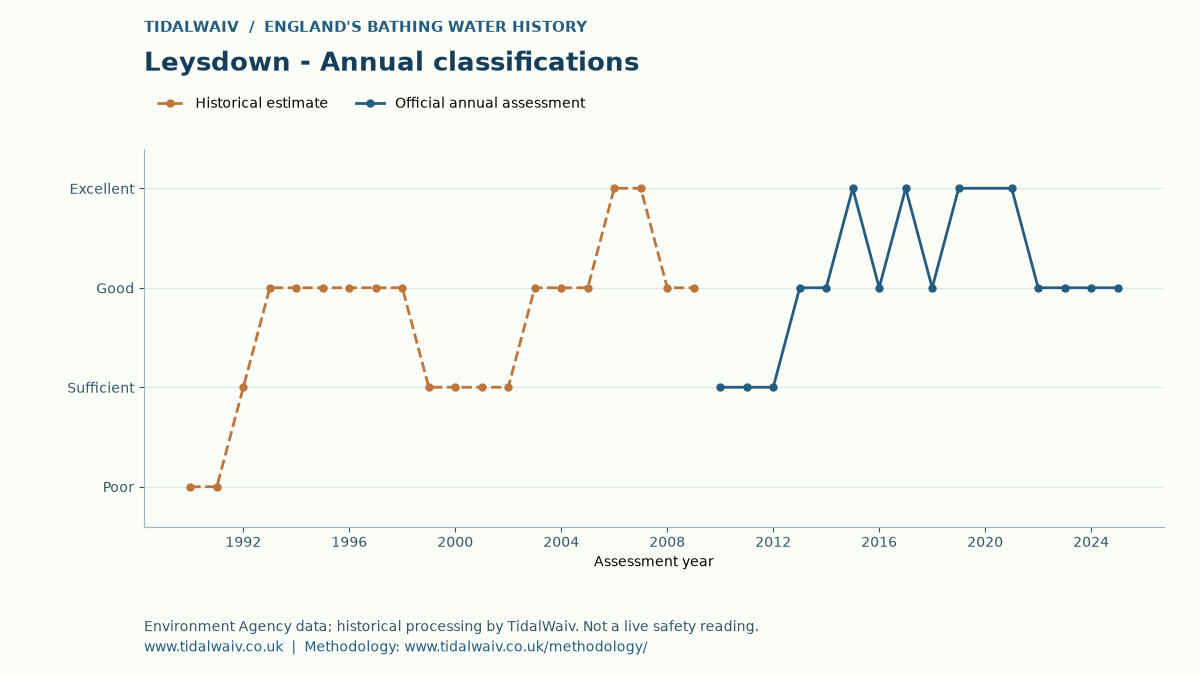
The rest of Sheppey does better. Sheerness has been Excellent every year since 2013, and Minster Leas was Excellent in 2025. Nationally, of 449 classified bathing waters in England, 297 were rated Excellent, 95 Good, 25 Sufficient and 32 Poor in their latest official classification.
3. "I could always get in the sea" as a boy: you still can, and the water is far cleaner now
Dyer is remembering the seaside of his childhood. He was born on 24 July 1977, so that means the late 1970s and the 1980s.
We can't test Canvey Island directly. TidalWaiv's record for Canvey Island Foreshore only starts in May 2026, with 20 samples and no classification yet. But every record that goes back that far points the same way: the sea was dirtier then, not cleaner.
England then. The EA's archive of results under the original 1976 Bathing Water Directive starts in 1988, the summer Dyer turned 11. That year only 229 of 352 English bathing waters (65%) met the directive's mandatory standard, and 123 failed. That was a 35% failure rate, and between 21% and 27% failed in each of the next three years.
In the government's 1988 results, 38 of the 65 bathing waters in the Southern Water Authority's area, which included Kent, failed. The same answer gave earlier years measured on the same basis: across England, Wales and Northern Ireland, only 51% of bathing waters passed in 1986 and 55% in 1987.
That "pass" was also a much weaker test than today's. The 1976 directive judged each bathing water on a single season's samples, mainly for total and faecal coliforms. To pass, 95% of samples had to be within the mandatory limits, which included 2,000 faecal coliforms per 100ml. Today's classifications use four years of samples and two indicators, E. coli and intestinal enterococci, with much tighter limits.
England then, by today's standards. Because today's test is far tougher, those old pass rates flatter the past. So we also judged the oldest records against today's standards. 1991 is the first year for which TidalWaiv has a full four seasons of data (1988 to 1991), the same length of record the EA uses now. That summer Dyer turned 14.
TidalWaiv's estimates rate 259 English bathing waters with both E. coli and enterococci data for that period. Only 143 (55%) would have met today's minimum standard of Sufficient. 102 (39%) would have been Good or better, and 43 (17%) Excellent.
Of those, 257 were still classified in 2025, and 142 of them had passed in 1991. In 2025 245 of them (95%) were at least Sufficient, 234 (91%) were Good or better and 188 (73%) were Excellent. In all, 194 were rated higher in 2025 than in the 1991 estimate, 62 the same and one lower (Weston-super-Mare Sand Bay, Sufficient to Poor).
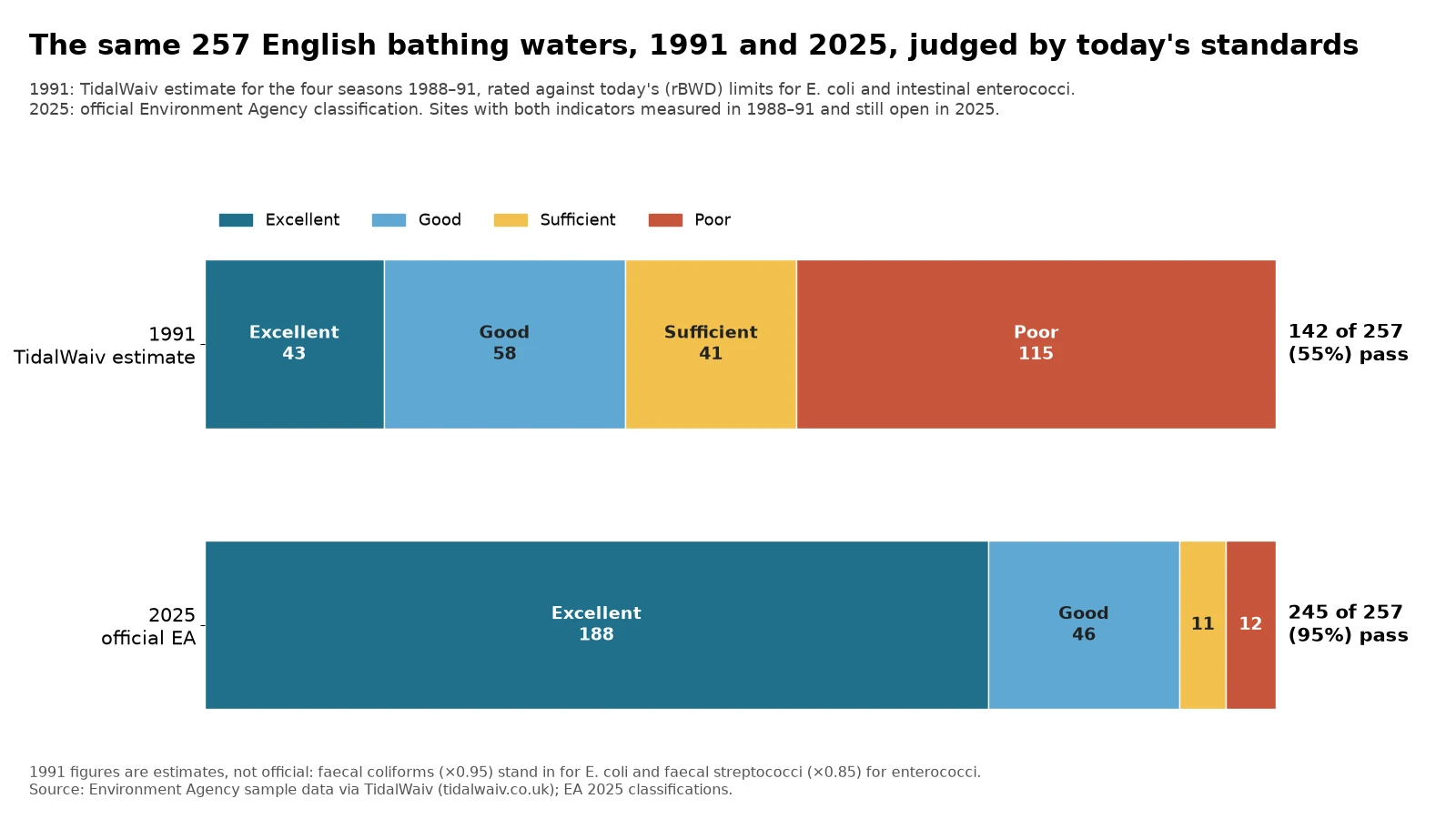
The 1991 figures are TidalWaiv estimates, not official results. Before 2012, samples were tested for faecal coliforms and faecal streptococci, which TidalWaiv converts into E. coli and enterococci equivalents.
The cause was no secret. In a 1991 House of Lords debate on the new EU sewage treatment law, Parliament was told that sewage from coastal communities "has been discharged to the sea, often untreated through short outfalls". The Urban Waste Water Treatment Directive (91/271/EEC), adopted that year, required treatment of significant coastal discharges.
Kent then. Along the coast from Sheppey, Herne Bay failed the mandatory standard every year from 1988 to 1992. Leysdown itself failed in 1989 and again in 1999.
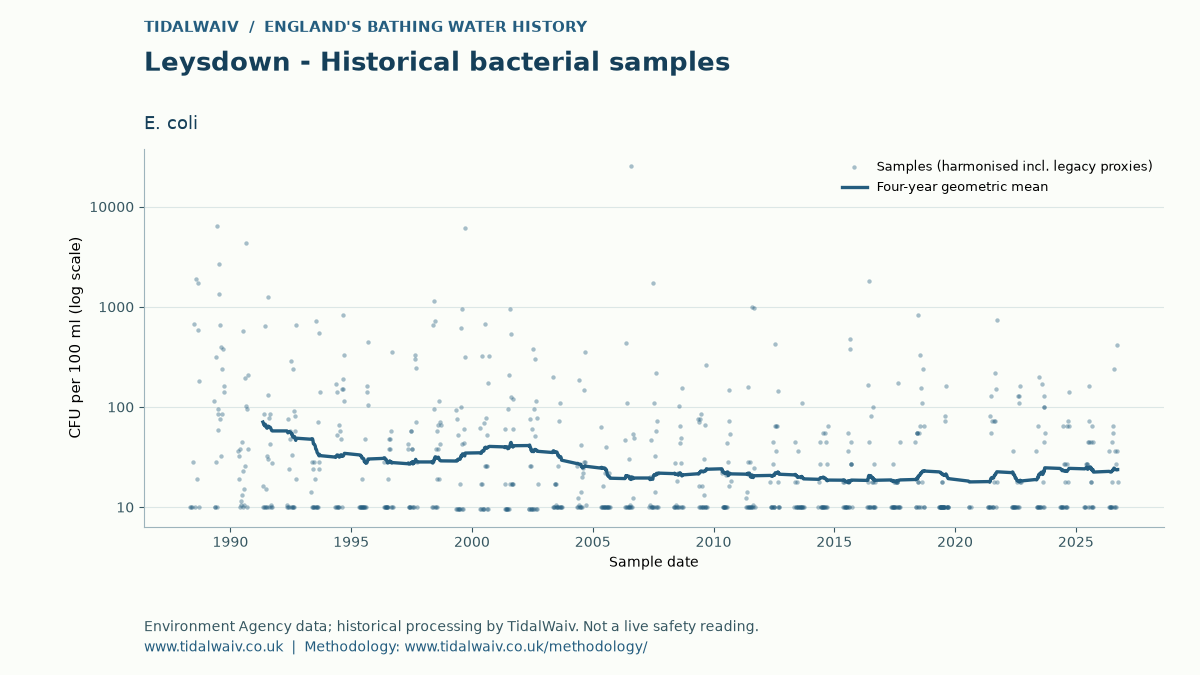
Leysdown then and now. TidalWaiv's Leysdown record starts on 5 May 1988, so we have no data for it before then.
- 1988 to 1990: 55 samples. Six were above 1,000 faecal coliforms per 100ml, and three broke the old legal limit of 2,000. The worst, on 6 June 1989, was 6,800.
- 2022 to 2026: 100 samples. None was above 500 E. coli. The highest was 420, on 9 September 2026.
- The bad end of the range: TidalWaiv's estimate of the 95th percentile for E. coli, from the two seasons 1988 and 1989, was about 2,600. In the official 2025 assessment it was 111.5, about 96% lower.
- The typical sample: the four-year average for E. coli, measured as a geometric mean, has fallen by two-thirds, from 71 when the series begins in May 1991 to 24 now.
The one measure that hasn't improved is intestinal enterococci, measured since 1990 (as faecal streptococci until 2011). They are roughly where they were, and they are what keeps Leysdown at Good rather than Excellent.
England now. In 2025, 417 of 449 English bathing waters (93%) met at least the minimum standard, and 297 (66%) were Excellent (Defra). That is under the revised directive, which the EA described in 2015 as "twice as tough to pass" as the old rules.
Like for like, 338 bathing waters on TidalWaiv have data for both 1991 and 2025. Their median 95th-percentile E. coli fell from 795 to 73. It was lower in 2025 at 334 of the 338, and the other four were already Excellent in 1991. In 1991, 219 of them were above 500, against 13 in 2025.
4. Bills are rising "to pump the sh*t into the sea": half right
Bills are going up, but mainly to pay for a much bigger investment programme, including work to cut spills, not for more spilling. Water UK calls it a "record £104bn investment programme", and Southern Water says it is spending £8.9bn on "the root causes of pollution" (BBC, BBC). Whether public ownership would do the job better is the political question, and the bathing water data can't answer it.
The verdict
Dyer is right that overflows still discharge sewage into the sea, including near Leysdown. He's right that this happens hundreds of thousands of times a year across England (292,119 counted spills in 2025), and that people are entitled to be angry about it and want it cut.
But on whether the sea is dirtier than it used to be, the evidence is one-sided. Leysdown, like English coastal waters generally, is significantly cleaner now than in his childhood:
- In 1988, the summer Dyer turned 11, more than a third of England's bathing waters (35%) failed a standard far weaker than today's. Leysdown failed it the following year, with one sample at 6,800.
- Judged by today's much tougher test, TidalWaiv's estimates suggest only 55% of English bathing waters would have passed in 1991, the summer he turned 14. Today 93% of England's bathing waters pass it, as do 95% of the waters rated for 1991.
- Leysdown passed the old directive's standard every year from 2010 to 2014 and has been rated at least Sufficient in every classification since then. It is rated Good and hasn't recorded an E. coli sample above 500 since 2021.
We can't measure Canvey in the 1980s. But at 334 of the 338 English bathing waters with data for both 1991 and 2025, the water is cleaner now, and the other four were already Excellent. The record gives no reason to think Canvey was the exception.
Spills are real and worth fighting. That case is stronger without the claim that things have got worse, because they have got much better.
Methodology and caveats
- Bathing water data. Figures come from EA sampling, processed by TidalWaiv (methodology). Official classifications are the EA's. Pass and fail results from 1988 to 2014 are the EA's own, under the 1976 directive. The first statutory classifications under the revised directive were for 2015. TidalWaiv's ratings for 2010 to 2014 come from EA compliance records on the revised directive's basis.
- Estimates before 2010. TidalWaiv's figures for years before 2010 are its own estimates from sample data, built on rolling windows of up to four seasons: 1988 is one season, 1989 two, 1990 three (1988–90), and from 1991 the full four that official classifications use. TidalWaiv rates those windows against the revised directive's limits, using log-normal 90th and 95th percentiles and the stricter of the two indicators. For coastal waters, Sufficient means 90th percentiles within 500 E. coli and 185 enterococci. Each indicator needs at least eight samples, so 1988 and 1989, with no enterococci data, can't be rated. Treat the long-run comparisons as approximate.
- Older samples. Samples before 2012 were tested for faecal coliforms rather than E. coli. TidalWaiv converts them into one series, using faecal coliforms (×0.95) in place of E. coli and faecal streptococci (×0.85), first measured in 1990, in place of intestinal enterococci.
- Classifications aren't live readings. Annual classifications are a four-year assessment, not a live safety reading. For conditions on the day, including short-term pollution warnings in the bathing season, check the EA's Swimfo.
- Overflow data. Overflow figures come from the EA's Event Duration Monitoring storm overflow annual returns: the 2025 return (revised August 2026) and the 2016–2024 long-term trends file. The EA counts spills in 12/24-hour blocks. "Linked to Leysdown" means the water company listed Leysdown as the bathing water for that overflow.
- Quotes are as reported by the outlets linked. Dyer's remarks were reported with expletives partly masked.
- TidalWaiv is independent and not affiliated with the Environment Agency.